
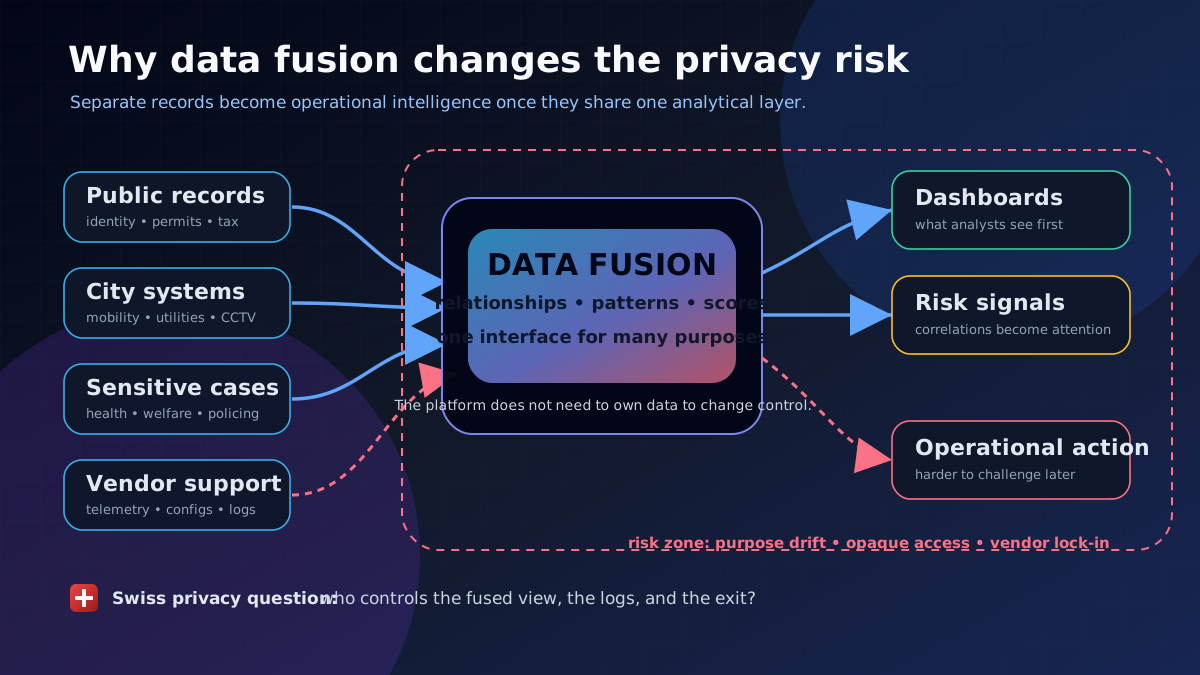
Zurich has a Palantir problem, and it is not only about one American company renting office space near the station.
The problem is what happens when a city known for trust, banking discretion, research, and Swiss legal restraint becomes a useful base for software built to fuse sensitive data into operational decisions. Palantir does not have to own the data to change the power structure around it. A platform that connects silos, models relationships, and turns fragments into profiles can become infrastructure before the public understands what has been installed.
*That is the uncomfortable part: the privacy risk can appear before there is any breach.*
Swiss reporting has placed Palantir's local operation at the center of a bigger question: what exactly is being developed, sold, supported, or legitimized from Switzerland? Business registry data lists Palantir Technologies Switzerland GmbH as a Zurich company founded in 2014, with UID CHE-494.525.737. Republik and SWI swissinfo have reported that Zurich serves as a hub for Palantir's business relations, with roughly 60 employees working in the city on development and distribution of software products.
Palantir has reportedly said that Gotham, its platform associated with intelligence, law enforcement, and military use, is not being developed in Zurich. The Zurich team is described as focused on Foundry, a platform more often marketed for civilian and commercial operations. That distinction matters. It also does not end the debate. Foundry can still be used by public bodies, critical infrastructure, and organizations handling sensitive records. The risk is not only the product label. The risk is the operational model.
A practical way to read the Zurich issue:
- A Swiss address proves presence, not control.
- A civilian product label does not guarantee civilian-only outcomes.
- A privacy promise is weak unless the architecture, contracts, logs, and exit plan prove it.
- A powerful data layer can become politically important long before citizens know it exists.
## Data fusion changes the rules
Most privacy failures are still discussed as leaks: a database exposed, a laptop stolen, a vendor breached. Palantir raises a different problem. The danger is aggregation.
A data-fusion layer is designed to make separate datasets useful together. In a company, that may mean logistics, procurement, fraud detection, or supply-chain analytics. In a state context, it can mean policing, border control, military intelligence, health records, social services, or crisis response. The same technical promise becomes a different political machine depending on who uses it.
Swiss privacy law is built around purpose, proportionality, transparency, and control. A data-fusion platform pushes against all four. Once records from different departments become searchable in one operational layer, purpose limitation becomes harder to prove. Once correlations produce flags, risk scores, or suggested leads, proportionality becomes less obvious. Once procurement teams describe the platform as a neutral tool, transparency becomes weaker precisely when the system becomes more powerful.
This is where Switzerland should be stubborn. Good. Stubbornness is a privacy feature.
## A Swiss address is not Swiss control
The easy public-relations line is that a Zurich office means local presence, local jobs, and local accountability. That is too thin.
A local subsidiary does not answer the hard questions. Who can access support telemetry? Which engineers can inspect configuration or customer environments? Which parent-company policies govern escalation? What happens when a foreign legal demand conflicts with Swiss expectations? Which modules were developed in Switzerland, and which are only sold or supported from here? What audit rights does the Swiss customer actually have, beyond contractual comfort language?
These are not paranoid questions. They are procurement questions. They are sovereignty questions.
Republik reported that Palantir courted Swiss federal authorities for years and was turned down multiple times. In its English account of the investigation, the outlet described 59 freedom-of-information requests and said Palantir was rejected at least nine times, including because agencies found the software unnecessary or feared reputational damage. It also reported that Swiss military concerns included the possibility that sensitive data could be accessed by the US government and intelligence services. The DDPS reportedly called that wording a precautionary risk assessment.
That phrase is doing a lot of work. Precautionary does not mean imaginary. It means the risk was serious enough that professionals responsible for state systems did not want to wave it away.

## The danger is institutional dependence
Palantir's best sales argument is also the reason it should worry privacy people. It makes messy organizations feel like they can finally see everything.
That is seductive. It is also dangerous.
Once a platform becomes the place where analysts work, workflows adapt around it. Data quality rules, access models, dashboards, alerts, and decision habits start living inside the vendor's world. After a few years, removing the platform is no longer a simple IT migration. It becomes an institutional withdrawal.
For Swiss public bodies, that is a bad bargain unless the rules are brutally clear from the beginning. Every deployment should have a lawful purpose, a public impact assessment where possible, strict data minimization, an independent technical audit, explainable access logs, retention limits, and a credible exit plan. If a buyer cannot explain how to leave the platform before signing, it should not sign.
## The correlation problem
The most human danger is not that the software produces a Hollywood-style all-seeing eye. It is that ordinary people become visible in ways they cannot challenge.
A person reports a crime. A person appears in a shared address. A person crosses paths with someone under investigation. A person is part of a network because the data says so, not because a court has tested the inference. Large analytical systems can turn weak signals into operational attention. Sometimes that attention is justified. Sometimes it is statistical smoke with a badge on it.
Republik reported that Swiss Army reviewers worried comprehensive collection and analysis could intrude on privacy and that people might be targeted unintentionally based on statistical correlations. That concern should be printed on the first page of every procurement memo for this class of software.
Switzerland should not outsource suspicion.
## Zurich inherits the reputational risk
Zurich benefits from being seen as careful. That reputation is valuable. It is also fragile.
If a company uses Zurich as a hub while its products are associated abroad with policing, military operations, migration enforcement, or war-zone targeting controversies, Zurich cannot pretend the ethical debate stops at the office door. SWI swissinfo reported that the Swiss foreign ministry had the company in its sights because of its controversial role in Gaza. Republik has reported on questions over whether certain activities may fall under Swiss rules on private security services abroad.
Those questions may end in narrow legal answers. Fine. But narrow legality is not the same as public legitimacy.
For Swiss data privacy, the lesson is bigger than Palantir. Switzerland is attractive to powerful technology companies because trust is part of the national brand. If that trust becomes a wrapper for opaque systems that concentrate decision power, the brand gets spent. Quietly at first. Then all at once.
## What a serious Swiss response should require
Swiss organizations do not need a blanket ban on every advanced analytics tool. That would be lazy. They need rules strong enough for the category.
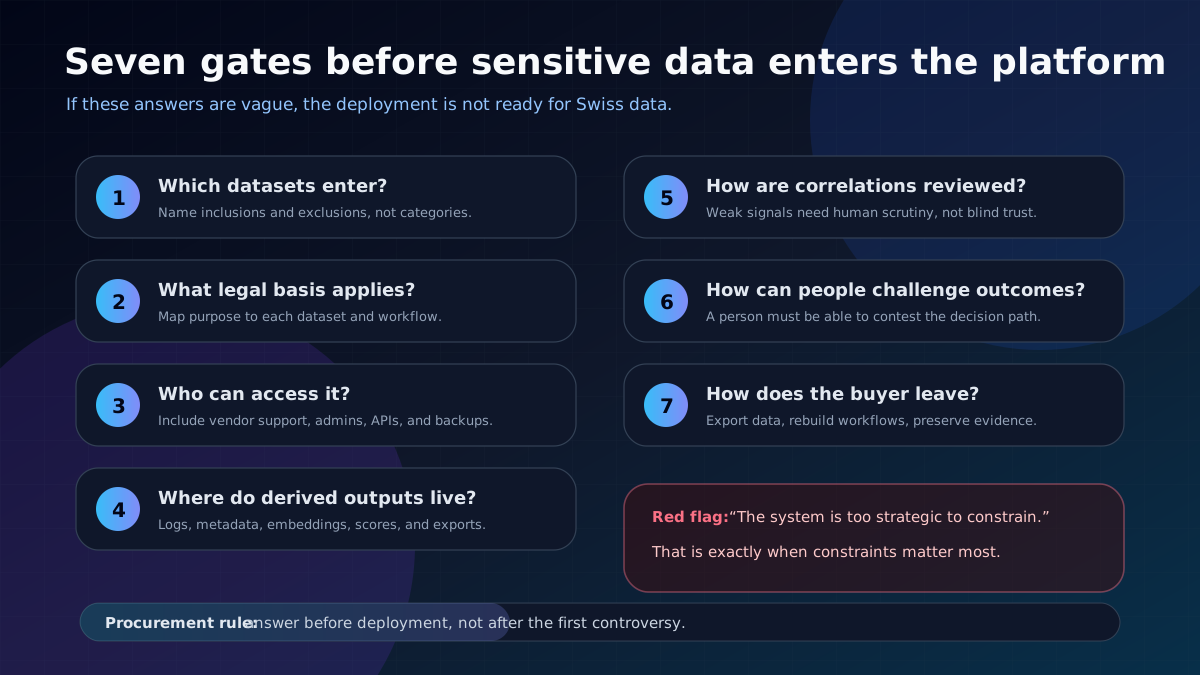
Before any Palantir-style data-fusion system touches sensitive Swiss data, the buyer should be able to answer seven questions in writing:
1. Which exact datasets enter the platform, and which are excluded?
2. What legal basis and purpose applies to each dataset?
3. Which humans and systems can access the data, including vendor support?
4. Where are logs, metadata, backups, embeddings, and derived outputs stored?
5. How are correlations, risk scores, and automated suggestions reviewed by humans?
6. How can affected people challenge decisions influenced by the system?
7. How does the organization leave the platform without losing operational control?
If the answers are vague, the system is not ready for Swiss data. If the vendor will not allow independent verification, the buyer should walk away. If management says the tool is too strategic to constrain, that is the signal to constrain it harder.
## The real danger
Palantir in Zurich is not dangerous because software is evil. That argument is childish, and Switzerland should be too serious for it.
The danger is that powerful data-fusion systems make surveillance, profiling, and institutional dependence feel like operational efficiency. They make exceptional access feel normal. They make broad collection feel prudent. They make the boundary between civilian, commercial, police, and military use easier to blur.
Zurich should be a place where those boundaries are defended, not a place where they are polished into a sales deck.
Switzerland has the legal culture to ask harder questions than most countries. It should use it. A local office is not enough. A privacy promise is not enough. A diagram about data residency is not enough.
For systems this powerful, trust has to be proven at the architecture level, the contract level, and the oversight level. Otherwise Zurich is not hosting innovation. It is hosting data gravity, and pretending gravity does not pull.
## Sources reviewed
- [SWI swissinfo.ch, "Why Palantir is becoming a risky bet for Switzerland", December 22, 2025](https://www.swissinfo.ch/eng/war-peace/why-palantir-is-becoming-a-risky-bet-for-switzerland/90666335)
- [Republik, "How tenaciously Palantir courted Switzerland", February 18, 2026](https://www.republik.ch/2026/02/18/how-tenaciously-palantir-courted-switzerland)
- [Republik, "Warum Palantir zum Risiko fuer die Schweiz wird", December 9, 2025](https://www.republik.ch/2025/12/09/warum-palantir-zum-risiko-fuer-die-schweiz-wird)
- [netzpolitik.org, "Palantir-Software hat verheerende Risiken", December 8, 2025](https://netzpolitik.org/2025/schweiz-palantir-software-hat-verheerende-risiken/)
- [Business Monitor, Palantir Technologies Switzerland GmbH company entry](https://business-monitor.ch/de/companies/621304-palantir-technologies-switzerland-gmbh)
- [Palantir, Gotham Europa product page](https://www.palantir.com/platforms/gotham/europa/)